Nobody gives you an S&OP job. You take it.
Many of you asked me the same question: “Edouard, how do I become S&OP manager, IBP director, or VP of IBP when my company has no process and no open position?” So I designed a mindmap with the full strategy, and this article walks you through it.
Even if there is no S&OP or IBP in your company today, you can create your own job. I will show you how to do it inside your company, how to find a job outside, and how to maximise your chances if you are a job seeker. S&OP and IBP are booming right now, even more with AI, and the opportunities are massive.
I covered all of this in the video below. If you prefer to read, the full breakdown continues underneath.
Here is the whole roadmap on one page. Find your situation before you read on.
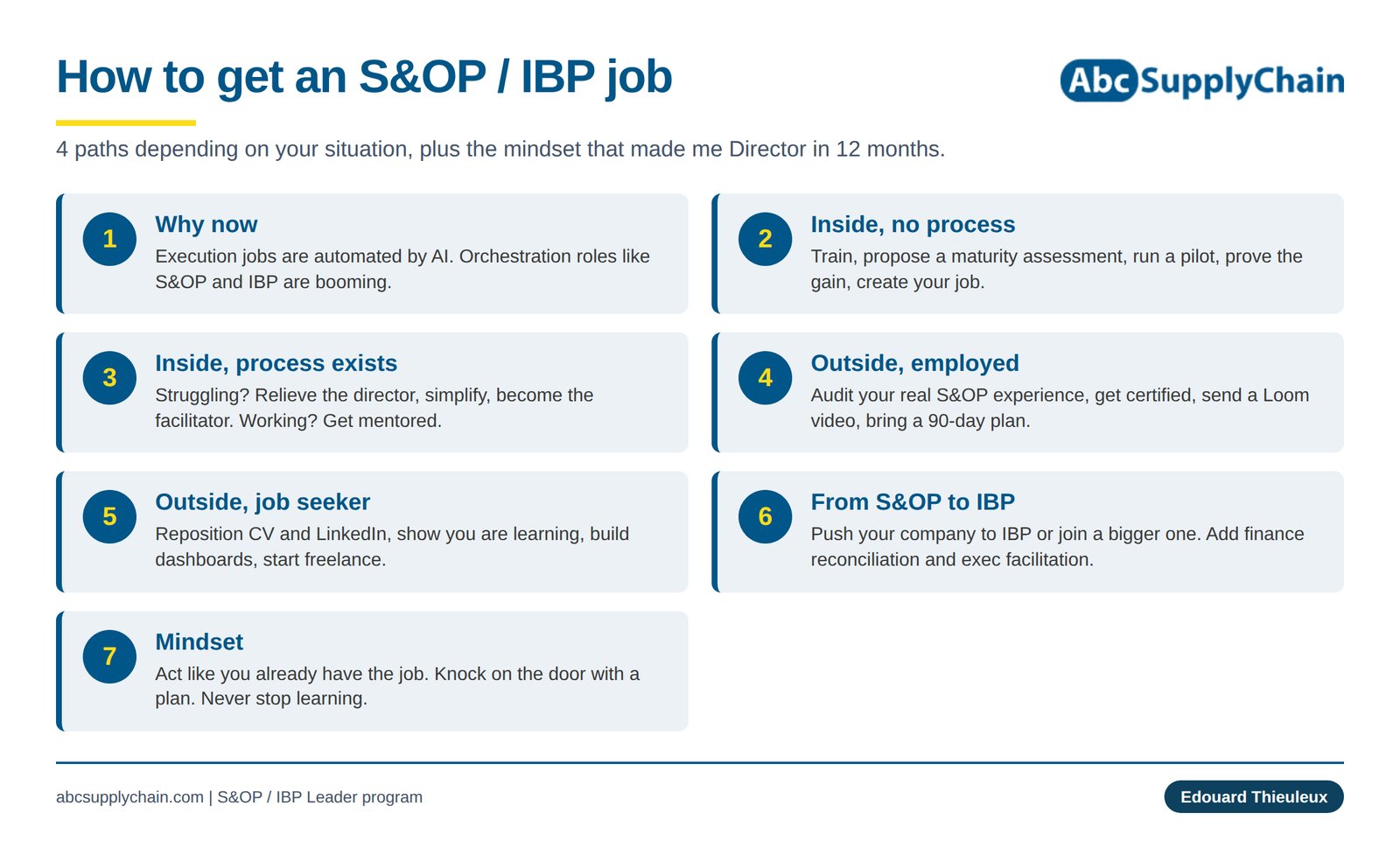
Why now: execution jobs are disappearing, orchestration jobs are booming
The job market in operations and supply chain is changing massively, and it is only the beginning.
Many jobs are being automated with AI. If you work as a demand planner, in planning, in procurement, or as an analyst, you may already feel it. In the meantime, all the decision and orchestration roles like S&OP and IBP are booming. You want to be on that side, with the winners.
Salaries are booming too, for a simple reason: it is hard to find the right profile. Very few people are trained on this topic with real experience.
My story. I became S&OP manager in 2017, and 12 months later I became Supply Chain Director. Why so fast? Because I was leading the S&OP executive committee, and that made me extremely visible to the top management. Since then I have trained hundreds of experts on this topic, and many of them got promoted to director or vice president the same way.
S&OP vs IBP: which job are you really targeting?
There is a lot of confusion between the two. They share the same goal: bring more collaboration and trust into the company. But you will find S&OP mostly in mid-size companies, and IBP in larger groups, with more finance, more business orientation, and a horizon of two to four years instead of next year. I explain it in detail in my article on the difference between S&OP and IBP.
Whatever the label, you will have to become a unicorn: technical expertise (supply chain, forecasting, analytics), a real understanding of the business, the ability to facilitate and orchestrate, and the ability to use AI to simplify and automate as many tasks as possible. That profile is rare, and that is exactly why these roles pay so well.
My example. Under my last video, Mark replied with one line: “I want to be a unicorn.” That is the right attitude. The goal is not to have good spreadsheets and the right capacity numbers. The goal is to support the business.
Path 1: Inside your company, when no S&OP process exists
Inside your company is the best opportunity you have, even if there is no S&OP yet. Why? Because a good S&OP or IBP leader needs trust, and trust takes years to build. You already have it where you are.
The prerequisite is legitimacy. If you are a demand planner, an analyst, a coordinator, a supply chain manager, a consultant, a project manager or an ERP expert, you do not have to quit and look for a job elsewhere. You can create your own job. Here is how.
- Train yourself first. You need to know what you are talking about. Learn the method, the meetings, the tools, and practice on your own scope.
- Take the initiative: propose a maturity assessment. A simple assessment gives your organisation a score on S&OP and IBP maturity: process, execution, analytics, leadership engagement. Most companies score at “firefighting” or “basic” level. Once you can show the score, the roadmap to level 4 or 5 becomes obvious, and so does the need for someone to lead it.
- Start small with a pilot. One brand, one division, one product family, or one topic: the sales gap, the forecast alignment between Finance, Sales and Supply Chain, the supply capacity, the finance reconciliation, the risks and opportunities. It can also be one tool, one dashboard, or one template for new products between Sales, Marketing and Supply Chain. You only need one entry point to prove that collaboration and alignment must improve.
- Prove the stake. Real need, real gain: better service, less inventory or cost, time and stress saved.
- Present to management. With the proof in hand, you justify the role. You are not asking for a promotion, you are showing a gap and offering to fill it.
My students’ stories. One of my students in a pharmaceutical company started S&OP on one single product, but it was one of the biggest of the company, around 40 million dollars of revenue, and extremely challenging. That one product was enough to prove the value of the process. Another client can only supply 70% of its customers in Chicago, so capacity became the entry point. And several of my clients and members created their S&OP job directly this way. It is, for me, one of the easiest paths when there is no S&OP yet, because you get to define your own role.
Path 2: Inside your company, when a process already exists
Maybe you are already a participant: demand review, supply review, finance side. Two cases.
Case 1: the process is struggling. This is the biggest opportunity. The signs are easy to spot: fights between departments, stress, no energy, overload, pressure.
- Be the proactive person who brings fresh ideas and optimism. Do not try to replace the manager.
- Offer to relieve the S&OP or IBP director by taking more responsibilities.
- Work on simplification and automation.
- Propose an assessment: “we are struggling, but where exactly?” A simple assessment shows the weak points and the next small steps.
- Become the facilitator who makes everyone’s life easier.
Even without the official label, behave like you are already the S&OP or IBP manager. The more you do, the more responsibility and visibility you get, and at one point the opportunity comes naturally. Or you go and say it: “I think it is time for me to become the new S&OP manager.”
Case 2: the process works very well. This is rare, but if you are lucky enough to be there, get inspired, ask to be mentored, ask for more responsibilities and deliver quickly, and be clear about your ambitions and your desire to learn. The closer you get to these leaders and the more value you deliver to them, the more opportunities you create.
My story. When the process works well, the people above you move fast to executive positions. That is exactly what happened to me. Your time will come.
And whatever happens, you have a safety net: if no opportunity opens, you now have solid experience to move to another business unit, another division, or another company.
Path 3: Outside your company, when you already have a job
Many people make the mistake of looking outside first. Start inside, and if you cannot create or find the job, then open the doors.
If you are employed and want an S&OP or IBP job elsewhere, recruiters will challenge your experience, because the title is probably not on your CV.
- Audit your experience honestly. Please do not lie. But you probably have experience in alignment, collaboration, forecasts, capacities, consensus, scenarios. Many people do S&OP without the S&OP label.
- Train in parallel. A certification as S&OP and IBP leader is visible on LinkedIn and reassures recruiters that you know what you are talking about.
- Target roles precisely and personalise. Do not spam.
- Come with a 90-day action plan. In the video you send, and at the interview, talk about what you would do if you got the role. Not “I am the expert”, but “here is my plan for your company”.
My example. I receive a lot of applications at AbcSupplyChain, and you can immediately see the ones written by AI and sent to a thousand companies. They get no results. What I do myself, with my clients and my students, including a CFO I work with on S&OP, is record a short personalised video with Loom (almost free). Share your screen, show the dashboards and tools you built or learned, and talk about your action plan. If you have no experience yet, use our tools to show what you can do. One of my students did exactly that with his own roadmap.
Your narrative is simple: “I already do S&OP, with or without the title. I want to go further, and I am looking for a company that gives me the opportunity to implement my ideas.”
Path 4: Outside your company, when you are between jobs
Reality check first: the longer the period without a job, the bigger the warning for recruiters. So turn the gap into a story of progression.
- Highlight your S&OP-related experience on your CV and LinkedIn. Ask AI: “I do not have the S&OP title, but I did this and this. What should I highlight to improve my visibility?” Many companies filter CVs with AI, so you need to pass that first filter.
- Show you are active, not just searching. You are not “looking for a job”. You are taking a training break to learn S&OP and AI.
- Build your own S&OP dashboards. An Excel or online dashboard you can show is worth more than any sentence on a CV, especially with a certificate next to it.
- Position yourself: “I used this break to upskill in what I am passionate about. I was the technical guy, the analytics guy, and now I want to become a facilitator of collaboration and trust for the business.”
- Offer to start as a freelance or consultant and deliver. The roadmap, the first tool, the first meeting.
My story. When I arrived in Australia, I was a backpacker. It was my dream, but nobody there knew me, and I had zero Australian experience even though I had been a supply chain manager before. So I started with a one-day contract: my job was to build Excel spreadsheets for S&OP. Then I got a two-day contract. Then two weeks. After about three weeks I got the demand planning position, and after two months I became the S&OP manager. Everything is possible. If you do not have a job: yes, you can. If you already have one: go for it.
Path 5: From S&OP to IBP
Maybe you are S&OP manager today and you want to become IBP manager or director. Same objectives, but more business and more finance, and it depends on the company size and ambition.
- Path A: after a successful S&OP adoption in a mid-size company, invite the company to move to IBP. “We now have a good level of maturity, let’s go to the next level.”
- Path B: apply to a larger company with more ambition on this topic. With strong S&OP results, it is very possible, because at the end it is almost the same job, just bigger.
Two skills to add: financial reconciliation and executive-level facilitation. And learn from the people who do it today. Get closer, get mentors.
My example. I run live sessions and a specific masterclass with Daniel, who became Vice President of Supply Chain and IBP. He shares how he leads a billion-dollar company with the IBP process, how he uses AI, and how he gained the trust of his CEO to get things done. That is the level to learn from.
The mindset that got me promoted
The mindset is the most important part at the end. Whatever job you target, behave like you already have it. If you are a demand planner, act as the S&OP manager of your perimeter. If you are a supply chain manager and you want to become IBP vice president, behave like the IBP vice president.
Go beyond your manager’s and director’s expectations. Propose improvement projects. Catch the waves: when an opportunity appears, do not wait to be called. Knock on the door of your HR or your director and say: “I want this job, here is my plan, and here is why you should choose me.”
I see many people get frustrated because they see the opportunity coming and they wait for someone to call them. Nobody calls. An S&OP or IBP role is facilitation and dealing with a lot of people, so the company wants someone who is comfortable speaking up and asking for what they want.
Far more people regret not trying than people who tried and failed. And you never really fail.
My story. I did fail at one point. After becoming director, I went through a burnout, and I realised this role was not for me. I am a teacher, a guide, a mentor, a coach. I am a much better facilitator than a manager of 50 or 200 people. That “failure” is what led me to build AbcSupplyChain and to train the people who are now directors and vice presidents. Trying is never a loss.
Be proactive, not passive. The opportunities are real, and there is a compound effect: the people who take the initiative today will keep getting the opportunities, while the others will suffer from competition and AI automation.
And never stop training and upskilling. With AI, skills become obsolete and commoditised very quickly. AI is learning the technical part, so we have to learn how to become humans again: facilitation, trust, decisions. If you want to avoid the classic traps once you are in the seat, read the 10 S&OP and IBP mistakes I made.
Want the full roadmap on one page? Download the complete mindmap (PDF, no email required).
Become a Certified S&OP / IBP Leader
The full practical playbook to design, implement and run an S&OP and IBP process, and to get the role from day one, with all the tools and methods I use, without changing your ERP.
- The 12 step implementation method you can apply on a pilot next week
- The maturity assessment to propose to your management
- 30+ ready-to-use tools, dashboards and executive deck templates
- The 90-day action plan structure for interviews and first months
- An official certification, live coaching and a community of S&OP and IBP leaders
Which path are you on today? Inside your company, outside, or between jobs? The best moment to start is now, while the roles are still opening faster than the candidates.
See you soon,
Edouard