In fifteen years of running S&OP and IBP processes, I made every mistake on this list. And I am sure that if you are an S&OP or IBP manager today, at least three or four of them are part of your role right now.
I covered all of this in the video below. If you prefer to read, the full breakdown continues underneath.
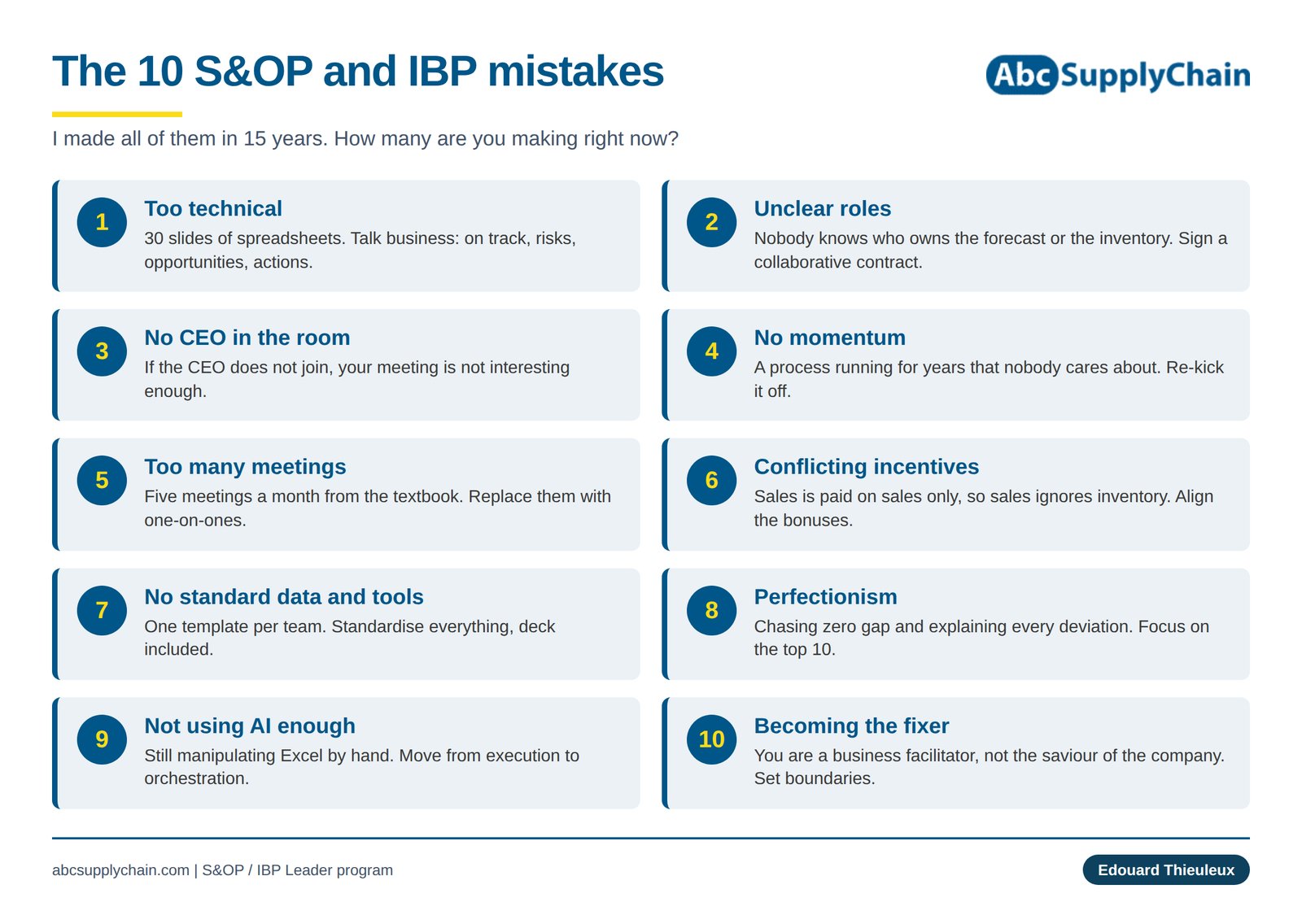
Here is the whole list on one page. Count how many are yours before you read on.
1. Your S&OP is too technical
Most of us come from supply chain operations. Engineering degree, master’s, spreadsheets everywhere. So naturally, the process ends up looking like us: technical.
I have sat in executive S&OP meetings with 20 or 30 slides of screenshots pulled straight from a spreadsheet or a BI tool. Way too much information, way too much detail about capacity and supply chain operations.
But the goal of S&OP and IBP is not to talk about supply chain. It is to talk about business. How do you support the company to reach its goals? How do you bring more collaboration, trust and alignment?
The executive committee needs four things from you:
- Are we on track?
- What are the main risks?
- What are the main opportunities?
- What can we do about it?
That is it. If your deck goes far beyond that, you will lose the CEO and the sales director within ten minutes, because it is boring and it is not their language. Keep it simple.
2. Nobody knows who is responsible for what
What is the real goal of your S&OP or IBP? What is the difference between the two? I wrote a full article on S&OP vs IBP, because the confusion starts right there.
Most people I see in an S&OP role are doing it part-time. They are supply chain manager, supply chain director and S&OP leader at the same time. Confusing for them, confusing for everyone else.
Two things I recommend.
First, consider changing the name. “Sales and Operations Planning” means nothing to a non-technical, non-engineer audience. Give the process a collaborative project name that means something inside your company.
Second, write down who owns what. Who is responsible for the forecast? Is there a frozen period? Who owns inventory? If these questions are not answered from the beginning, you will get endless fights between sales, marketing, supply chain, operations and finance.
What I teach is a collaborative contract, signed off by every member of the executive committee. Once it is signed, it is clear, and you can move on.
3. The CEO is not in the room
This is the one I see most often. The CEO is not involved, sometimes does not even know what is really happening in the process. When I ask why, the answer is always the same: “The CEO is very busy, he just asked me to send the memo after the meeting.”
For me this is a big mistake, and I will be blunt about the reason. If your CEO is not joining your executive S&OP or IBP meeting, it is not because he is too busy. It is because your meeting is not interesting enough. Not business enough.
My own CEO did not join at the beginning either. What changed his mind was realising that this was the one meeting where he could see the truth: are we on track, are we behind, what are the real risks and opportunities, and what can we do about it. Once he saw that, the S&OP meeting became the most important meeting of his month.
So make it great. And build the relationship outside the meeting: monthly or quarterly catch-ups with the CEO, to build trust and to secure his support. You will need it for the hard decisions, and you will need it so that transforming the company does not rest on your shoulders alone.
4. There is no momentum
Many companies have had an S&OP process running for years. And you can feel it: nobody is excited anymore. It is a lot of meetings. People complain. “I have to provide the forecast again. I have to do my root cause analysis again. I have four or five meetings a month on this.”
No momentum, no results.
My recommendation when you inherit this situation: re-kick off the process. Maybe under a new name that is not S&OP or IBP. And make sure the CEO says it out loud in front of the executive team: “This is one of the main priorities of the company this year, and Edouard has my full support.”
Without that momentum and that visible sponsorship, improving your current situation is going to be very, very difficult.
5. Way too many meetings
Zoom, Teams, Google Meet. Five meetings a month because that is the classic S&OP cycle from the books. Ten or twenty people in each one, only a few of them speaking, the rest checking their phone.
It is not efficient, it is boring, and it rarely ends with a real action plan.
Here is what I do instead. I cut the number of meetings massively and keep only the people who can actually take a decision in the room. And I replace big meetings with one-on-one coffee catch-ups: once a month with the sales director, with finance, with marketing. Just to feel the pace and focus on the decisions that matter.
Before the executive meeting, I also do a few quick one-on-ones to make sure everyone is on the same page, especially where I feel friction, for example with the sales director. That way, when we are in front of the CEO, we are aligned.
And one more thing if you work remotely: at least once a quarter, go and see the people you work with in real life. Working only online is exhausting, and you never really feel connected.
6. Conflicting goals, bonuses and incentives
Companies complain that sales does not care about inventory or forecast quality. Then you look at the bonus scheme: sales is only rewarded on sales.
Of course they focus on sales. Nobody pays them to improve the cash flow of the company.
This is a higher-level fix, and it is exactly why you need the CEO and the CFO on board. Align the bonuses so that everyone is fighting for the same thing and there are no conflicting priorities inside the company.
It is not easy to change, and it can take a few years. But it removes a huge amount of friction and makes collaboration and trust a lot simpler.
7. No centralised, standardised data and tools
This one is tough. Take new product forecasting: every product manager uses a different template, every sales team sends its numbers on a different tool or platform.
One of my first goals in any S&OP role is to simplify and standardise. For new products, for example, I give my Forecasting Expert students one simple Excel template, and everyone uses the same one. No new software to buy.
The same applies to you as an S&OP or IBP manager. You should not spend two or three days every month building your deck. It should be a standardised deck with standardised reports, where you copy and paste a few numbers and charts and spend your time on the analysis and the decisions the executive committee needs to make.
And today, AI makes this standardisation much faster. More on that in mistake 9.
8. Perfectionism
The typical trap: we want one forecast in the company, so I spend days and nights trying to get zero gap between the sales forecast, the supply chain forecast and the finance forecast.
It is a mistake. Life is moving, the company is moving. You will never have perfect alignment, unless you accept to run a single forecast for the whole company, which is not always the case.
The other version of perfectionism: trying to explain everything. Every root cause, every deviation. It was exhausting for my supply chain team, and it was exhausting for sales.
Focus on the top 10 gaps, the top 10 customers, the top 10 products and suppliers. Do not try to explain everything, or you will spend more time analysing the past than creating opportunities for the business.
9. You are not using AI enough
AI is everywhere, and yet I still see a lot of S&OP and IBP leaders running the process old school: heavy Excel manipulation, a lot of noise, a lot of manual work.
AI can help you simplify, standardise, build small apps that make your life easier, create your deck faster, analyse data and support decisions. And the good news is that you do not need to change your software anymore. You can build very quick apps, or even spreadsheets, with Claude for example.
The real shift is this: stop spending your time on execution and spend it on orchestration of the S&OP and IBP process. That is where the value of your role is.
AI is now part of my S&OP / IBP Leader program for this reason. But whatever you do, start using it every day, if not every hour, to do more with less.
10. You become the fixer and the saviour of the company
This last one is very personal.
If you are responsible for S&OP or IBP, do not become the fixer of the company. I recently had a large group of S&OP and IBP leaders with me, and most of them were exactly that: the CEO or someone else asks “please fix this”, and they fix it. Every time.
That is not your role. Your role is business facilitator. Aligning everyone and building collaboration is not an easy task, and if you are the only one accountable for it, you will absorb all the stress and all the emotions of the company.
In 2018 I did a burnout because I had no boundaries on this.
So be very clear about what your responsibilities are, and what they are not. Set emotional and professional boundaries. Protect yourself. That is my last piece of advice, and it is the mistake I suffered the most from.
Become a Certified S&OP / IBP Leader
The full practical playbook to implement and run an S&OP and IBP process, and to become an S&OP and IBP leader from day one, with all the tools and methods I use, without changing your ERP.
- The 12 step method, from role clarity to executive meetings
- The maturity assessment across all 7 pillars
- The executive deck template that gets your CEO in the room
- AI applied to S&OP and IBP, from execution to orchestration
- Live coaching and a community of S&OP and IBP leaders
These roles are booming right now. If you are curious, this is the time.
Let me know in the comments which of these mistakes you have made yourself.
Keep it simple, and bring more collaboration and trust into your organisation.
Edouard